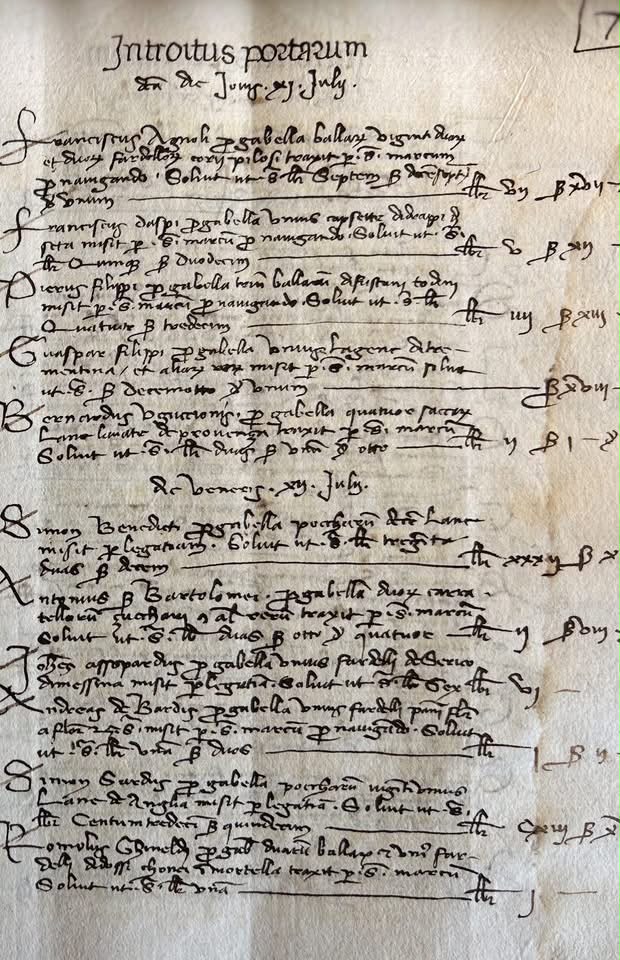
In the gabelle registers, an almost endless flow of goods emerges - some of them distant ancestors of products still in use today, often without us reflecting on their long history of circulation and transformation. Among these appears turpentine: in an early 15th-century record, it is documented as being brought into Pisa by a certain Guaspare Filippi - possibly an apothecary - contained in a flask and taxed at an entry duty of eighteen soldi and one denaro. The substance was clearly considered valuable.
From the late 14th-century Codex Historia Plantarum, we learn that turpentine was attributed multiple therapeutic properties. It was believed to relieve itching in intimate areas, ease chest ailments, and even help fix eyelashes - functioning, in a sense, as a kind of medieval mascara! Derived from the terebinth tree, its resin, once distilled, produced the turpentine itself. Through entries like these preserved at the Archivio di Stato di Pisa, we can trace not only the movement of goods, but also the shifting boundaries between medicine, commerce, and everyday life in medieval Tuscany - an early form of material circulation that echoes ideas of circular economy long before the term existed